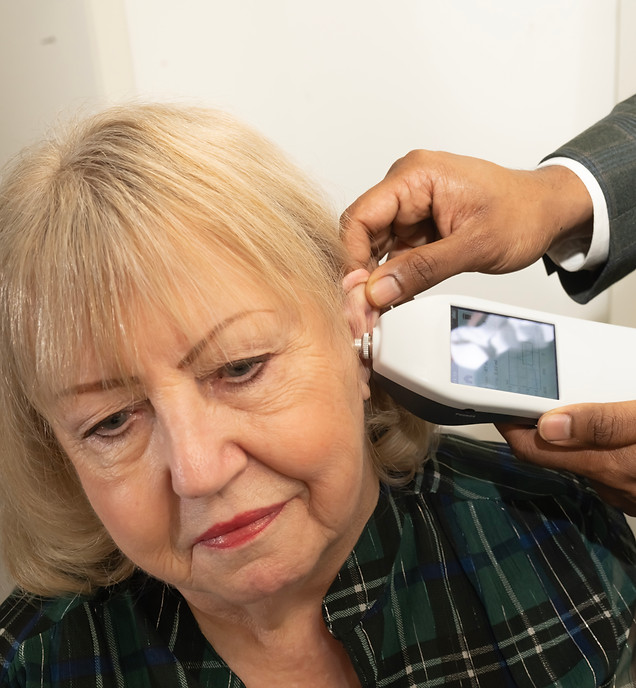
Many people assume a hearing test is simply putting on headphones, pressing a button when they hear a beep, and receiving a graph at the end. That type of test is important, but it only tells us part of the story.
Two people can have very similar results on an audiogram and still experience very different difficulties in everyday life. One person may cope reasonably well in restaurants and family gatherings, while another may struggle as soon as background noise is introduced. That is why not all hearing tests are the same.
A more detailed hearing assessment looks beyond pure-tone testing. Depending on the individual, it may include middle-ear testing, speech testing and speech-in-noise testing. The aim is not only to understand what sounds you can hear, but also how clearly you understand speech in real-world situations.
Hearing a Sound Is Not the Same as Understanding Speech
Pure-tone audiometry tells us the quietest tones you can hear across different frequencies and helps identify the type and degree of hearing loss. But everyday life is not made up of beeps — it is made up of conversations.
Many people tell us, “I can hear people talking, but I can’t always make out what they are saying.” That is where speech testing becomes important. It helps us understand how clearly your hearing system processes spoken words, not just whether you can detect sound.
Why Speech-in-Noise Testing Matters
For many people, the biggest difficulty is not hearing one person in a quiet room. It is hearing in restaurants, meetings, family gatherings, cafés or other busy environments.
Speech-in-noise testing is designed to reproduce this challenge in a controlled way. Speech is presented together with background noise, allowing us to measure how much separation between speech and noise you need before conversation becomes easier to understand.
This can reveal difficulties that a standard audiogram does not show. Two people with similar hearing loss may perform very differently in background noise, and that can influence which hearing-aid technology is most appropriate.
How This Helps Choose the Right Hearing Aid
Modern hearing aids are available at different technology levels, and one of the biggest differences between them is how they manage complex listening environments. More advanced technology may include stronger directional microphones, better background-noise management, AI-based processing and more sophisticated handling of changing conversations.
However, not everybody needs the highest level of technology. Someone who performs well in speech-in-noise testing and mainly has quiet one-to-one conversations may have very different needs from someone who struggles significantly in noise and regularly attends meetings, restaurants or social events.
This is why the hearing test should help guide the technology, rather than choosing a hearing aid first and trying to make it fit the person.
Testing Your Real-World Difficulties
A good hearing assessment should also relate the test results back to your everyday life. We want to know where you actually struggle — whether that is with television, your partner’s voice, meetings, grandchildren, restaurants, the car or larger social gatherings.
By combining your audiogram, speech results, speech-in-noise results and lifestyle needs, we get a much clearer picture of what you actually need from a hearing aid.
The purpose of an advanced hearing assessment is not simply to perform more tests. It is to answer better questions: How well do you hear speech? How well do you understand it? What happens when noise is introduced? And what level of technology is likely to help you most?
Because when it comes to choosing hearing aids, the question should not simply be:
“How much hearing loss do you have?”
It should also be:
“How does your hearing loss affect the way you live?”